
The Dirty Truth About Carpet Cleaning Chemicals: Why Neutralized, Residue-Free Cleaning Is the Only Safe Choice for Your Family
Most carpet cleaning companies are leaving toxic chemical residue deep in your carpet fibers — and your children, your pets, and your carpet warranty are all paying the price. This is the complete, unfiltered truth about carpet cleaning chemicals, optical brighteners, carpet protectors, warranty requirements, and why neutralized cleaning is not a luxury — it is a necessity.

I have been cleaning carpets for over 23 years. I have been inside thousands of homes across Colorado Springs. I have seen things in this industry that most homeowners would find genuinely alarming — not because carpet cleaning is inherently dangerous, but because the way the majority of companies in this industry approach it absolutely is.
This is the article I have wanted to write for years. The one that tells you everything the industry does not want you to know. The one that explains why your carpet looks clean after a standard cleaning but your dog is still chewing its paws, your child still has a rash, and your carpet still smells faintly chemical weeks later.
Read this carefully. Share it with every homeowner you know. The information here could protect your family, your pets, your carpet, and thousands of dollars in flooring investment.
The Chemical Problem Nobody in the Industry Talks About
Let's start with the fundamental issue that drives everything else in this article.
When a carpet cleaning company arrives at your home, they mix cleaning solution into their water supply and inject it into your carpet under pressure. The solution loosens soil, breaks down grease, and suspends particles so they can be extracted. That is the basic chemistry of carpet cleaning, and it works.
The problem is what happens after the extraction.
No carpet cleaning machine — not even the best truck-mounted unit on the market — extracts 100% of the water and solution it injects. A portion of that solution remains in the carpet fibers, in the backing, and in the padding beneath. In a standard cleaning, that residue dries in place. It does not evaporate. It does not neutralize itself. It sits there, in the fibers your children crawl on, in the surface your pets sleep on, in the material your family breathes near every single day.
Now consider what is in that solution.
The most commonly used carpet cleaning chemicals include:
- Alkaline detergents and surfactants — Most carpet cleaning solutions are highly alkaline (pH 10–12). They are effective at cutting grease and lifting soil, but alkaline residue left in carpet fibers is harsh, sticky, and attracts new soil rapidly. It is also a significant irritant to skin and mucous membranes.
- Solvents — Used to break down oil-based stains. Many common carpet cleaning solvents contain compounds that are classified as skin and respiratory irritants, and some have been linked to neurological effects with repeated exposure.
- Optical brighteners — We will cover these in detail below, but the short version is: they are synthetic fluorescent chemicals that make carpet look brighter under UV light, they do not clean anything, and they are persistent environmental contaminants that accumulate in carpet fibers and have documented effects on aquatic ecosystems and potentially on human health.
- Fragrances and deodorizers — Many contain synthetic musks and volatile organic compounds (VOCs) that are respiratory irritants. "Fresh scent" does not mean safe.
- Antimicrobial agents — Some companies add antimicrobial chemicals to their solutions. While the intent is to kill bacteria and mold, many of these compounds are skin sensitizers and can cause allergic reactions with repeated exposure.
- Phosphates — Found in some older or lower-quality cleaning formulations. Phosphates are effective cleaners but are environmental contaminants and can cause skin irritation.
When these chemicals are left as residue in your carpet — which they are, in virtually every standard cleaning — your family is in contact with them continuously. Every time someone walks barefoot across the carpet. Every time a child sits on the floor. Every time a pet lies down for a nap.
Real Consequences: When Carpet Cleaning Chemicals Hurt the Ones You Love
I want to be direct about something I have witnessed personally in over two decades in this industry. These are not hypothetical risks. These are things I have seen happen to real families in real homes.
Pets Chewing Their Paws Off
This is the one that haunts me most. I have personally seen dogs — family pets, beloved animals — chewing their own paws raw. Obsessively. Relentlessly. To the point of bleeding, infection, and veterinary intervention.
The owners were baffled. The vets treated the symptoms — antibiotics, cone collars, anti-itch medications — without identifying the cause. The behavior continued.
In multiple cases, the cause was the carpet. Specifically, the alkaline chemical residue left by a carpet cleaning company that did not neutralize its solution after cleaning. Dogs spend enormous amounts of time on the floor. They lick their paws constantly. They are ingesting whatever is in the carpet fibers every time they groom themselves.
Alkaline detergent residue on a dog's paw pads causes chemical irritation. The dog licks to soothe the irritation. The licking introduces more chemical to the mucous membranes of the mouth. The irritation spreads. The behavior escalates. What started as a chemical burn on the paw pads becomes a compulsive behavior that persists even after the initial irritation has healed.
I have seen dogs at the vet fighting for their lives from complications of this cycle. I have seen families spend thousands of dollars on veterinary care for a problem that originated in their carpet.
Cats are affected too, though their grooming behavior makes the connection harder to identify. Cats that develop skin conditions, excessive grooming, or gastrointestinal issues after a carpet cleaning should have chemical exposure considered as a potential cause.
Children With Rashes, Skin Irritation, and Respiratory Symptoms
Children are the most vulnerable human occupants of any home when it comes to carpet chemical exposure, for several reasons:
- They spend more time on the floor than adults — crawling, playing, rolling, sitting directly on the carpet surface
- Their skin is thinner and more permeable than adult skin, meaning chemicals are absorbed more readily
- Their immune systems are still developing and are more reactive to chemical sensitizers
- They breathe air closer to the floor, where chemical off-gassing from carpet is most concentrated
- They put their hands in their mouths constantly, directly ingesting whatever is on the carpet surface
The symptoms I have seen in children living in homes with chemically contaminated carpet include:
Skin reactions:
- Contact dermatitis — red, itchy, sometimes blistered rashes on any skin that contacts the carpet: legs, arms, hands, cheeks
- Hives that appear and disappear without an obvious trigger
- Eczema flares that worsen after carpet cleaning and improve when the child spends time away from home
- Persistent dry, cracked skin on the hands and feet
Respiratory reactions:
- Chronic cough, particularly at night when the child is on the floor or in a room with recently cleaned carpet
- Wheezing and asthma-like symptoms
- Frequent upper respiratory infections
- Chronic runny nose and congestion that does not respond to allergy medication
Gastrointestinal reactions:
- Nausea and stomach upset — particularly in toddlers who mouth objects that have been on the carpet
- Unexplained vomiting
The pattern that should alarm every parent: symptoms that improve when the child is away from home — at school, at grandparents' house, on vacation — and return when they come back. This is the hallmark of indoor chemical exposure, and carpet is one of the most common sources.
I have spoken with parents who spent months taking their children to allergists, dermatologists, and pediatricians before anyone suggested looking at the carpet. In every case, the symptoms resolved or dramatically improved after the carpet was properly cleaned with neutralized, residue-free chemistry.
What Optical Brighteners Are — And Why They Have No Business Being in Your Carpet
Optical brighteners — also called fluorescent whitening agents (FWAs) or optical brightening agents (OBAs) — are synthetic chemical compounds that absorb ultraviolet light and re-emit it as visible blue light. The effect is that treated surfaces appear brighter and whiter to the human eye than they actually are.
They are used in laundry detergents to make white clothes look whiter. They are used in paper manufacturing to make paper look brighter. And they are used by many carpet cleaning companies to make carpet look cleaner after a cleaning — even when it is not.
Let that sink in. Optical brighteners do not clean carpet. They do not remove soil, bacteria, allergens, or odors. They make carpet look cleaner by making it fluoresce more brightly. It is a cosmetic trick — a way to make a mediocre cleaning look like a great one.
Here is why optical brighteners in carpet are a problem:
They Are Persistent
Unlike cleaning agents that are designed to be rinsed away, optical brighteners are designed to stay. That is their entire purpose — to remain in the fiber and continue producing the brightening effect wash after wash. When a carpet cleaning company uses a solution containing optical brighteners, those compounds are deposited in your carpet and stay there. They do not break down quickly. They accumulate with repeated applications.
They Are Skin Sensitizers
Optical brighteners are classified as skin sensitizers — meaning they can cause allergic sensitization with repeated exposure. Once sensitized, a person can develop allergic reactions to even trace amounts of the compound. This is particularly concerning for children, whose immune systems are still developing and who are more susceptible to sensitization.
They Are Environmental Contaminants
Optical brighteners are persistent in the environment and are toxic to aquatic organisms. They are classified as environmental contaminants in many regulatory frameworks. When carpet containing optical brightener residue is eventually disposed of, those compounds enter the waste stream.
They Are a Diagnostic Red Flag
If a carpet cleaning company is using optical brighteners, it tells you something important about their philosophy: they are more interested in how your carpet looks than in how clean it actually is. A company that uses optical brighteners to make carpet appear cleaner is not a company that is focused on your family's health or the long-term condition of your carpet.
At Absolute Floors & More, we do not use optical brighteners. We do not need to. When carpet is genuinely clean — when the soil, bacteria, and allergens have been properly removed and the chemistry has been properly neutralized — it looks clean because it is clean.
The Science of pH and Why Neutralization Is Non-Negotiable
To understand why neutralized cleaning matters so much, you need to understand basic pH chemistry.
The pH scale runs from 0 to 14. A pH of 7 is neutral — pure water. Below 7 is acidic. Above 7 is alkaline (also called basic). The scale is logarithmic, meaning each step represents a tenfold change in acidity or alkalinity.
Carpet fiber chemistry:
- Most carpet fibers — nylon, polyester, wool, olefin — have a natural pH in the slightly acidic to neutral range (approximately 4.5–7)
- Carpet dyes are set at specific pH levels and are stable within a certain pH range
- Carpet backing and adhesives are also pH-sensitive
Standard carpet cleaning chemistry:
- Most carpet cleaning pre-sprays and solutions are highly alkaline — pH 10 to 12
- This alkalinity is what makes them effective at cutting grease and lifting soil
- But alkaline chemistry left in carpet fibers causes problems:
- It attracts soil — alkaline residue is sticky and acts as a soil magnet, causing carpet to re-soil faster after cleaning
- It damages fibers — prolonged alkaline exposure degrades nylon and wool fibers, causing them to become brittle, dull, and prone to matting
- It fades dyes — alkaline residue can cause color shift and fading, particularly in wool and natural fiber carpets
- It irritates skin — alkaline compounds are chemical irritants at the concentrations found in carpet cleaning residue
What neutralization does: After cleaning with an alkaline solution, a properly formulated acidic rinse is applied to bring the carpet's pH back to its natural range — approximately 4.5 to 6. This process:
- Neutralizes the alkaline cleaning chemistry, rendering it inert
- Stops the soil-attracting effect of alkaline residue
- Protects carpet fibers from ongoing alkaline damage
- Removes the chemical irritant from the surface your family contacts
- Leaves the carpet in a chemically stable state that is safe for children and pets
The difference between a carpet cleaned with neutralization and one cleaned without it is not subtle. The neutralized carpet stays cleaner longer, feels softer, looks better, and is genuinely safe for the people and animals who live with it.
Your Carpet Warranty: What It Actually Requires
Here is something that surprises most homeowners: your carpet warranty almost certainly has specific cleaning requirements — and if you do not follow them, your warranty is void.
Most major carpet manufacturers — Shaw, Mohawk, Stainmaster, Karastan, and others — require professional hot water extraction (steam cleaning) at specific intervals to maintain warranty coverage. But the requirements go beyond just the cleaning method. Here is what the fine print typically says:
Cleaning Frequency Requirements
Most carpet warranties require professional cleaning every 12 to 18 months to maintain coverage. This is not a suggestion. It is a contractual requirement. If your carpet develops a defect — premature wear, delamination, color loss — and you cannot document regular professional cleaning, the manufacturer can and will deny your warranty claim.
Keep your cleaning receipts. Document every professional cleaning with the date, the company name, and the method used. This documentation is your warranty protection.
Cleaning Method Requirements
Most warranties specify hot water extraction (also called steam cleaning) as the required method. Dry cleaning methods, bonnet cleaning, and shampooing do not meet warranty requirements for most major carpet brands. If a company offers you a "quick dry" or "no moisture" cleaning, ask specifically whether it meets your carpet manufacturer's warranty requirements. In most cases, it does not.
pH Requirements — The One Nobody Tells You About
This is the requirement that most homeowners — and many carpet cleaning companies — do not know about. Several major carpet manufacturers, including Shaw and Mohawk, specify in their warranty documentation that cleaning solutions must be pH-neutral or near-neutral, and that the carpet must be rinsed to a neutral pH after cleaning.
Shaw's warranty documentation states that cleaning solutions should have a pH between 5 and 10, and recommends rinsing with clean water after cleaning. Mohawk's warranty documentation similarly specifies the use of cleaning solutions that are safe for carpet fibers and recommends professional cleaning that includes a thorough rinse.
What this means in practice: if a company cleans your carpet with a highly alkaline solution and does not neutralize it, they may be leaving your carpet in a condition that technically voids your warranty — even though you paid for a professional cleaning.
Stain Protector Requirements
Many carpet warranties — particularly those for stain-resistant carpets like Stainmaster — specify that carpet protector must be reapplied after each professional cleaning to maintain the stain resistance warranty. We will cover this in detail in the next section.
Carpet Protector: Why Reapplication After Every Cleaning Is Essential
When your carpet was manufactured, the fibers were treated with a fluorochemical protector — most commonly a product in the Scotchgard or Teflon family. This protector does several important things:
What carpet protector does:
- Creates a molecular barrier around each carpet fiber that repels water, oil, and soil
- Causes spills to bead up on the surface rather than immediately penetrating the fiber
- Gives you time to blot up spills before they become stains
- Reduces the amount of soil that bonds to the fiber, making vacuuming more effective
- Makes professional cleaning more effective — soil releases more easily from protected fibers
- Slows the rate at which carpet re-soils after cleaning
The problem: carpet protector wears off
Carpet protector is not permanent. It degrades with foot traffic, UV exposure, and — critically — with cleaning. Every time carpet is cleaned, a portion of the protector is removed along with the soil. After one or two professional cleanings without reapplication, most carpets have lost the majority of their factory-applied protector.
This is why carpet that was stain-resistant when it was new becomes progressively less resistant over time. It is not that the carpet has changed — it is that the protector that made it stain-resistant has been cleaned away and never replaced.
What happens without protector:
- Spills penetrate immediately rather than beading up, dramatically increasing the likelihood of permanent staining
- Soil bonds directly to the fiber rather than sitting on the surface, making it harder to remove
- Carpet re-soils faster after cleaning
- The carpet looks dull and worn even when it is relatively new
- Stain warranty coverage may be voided
Reapplication after every cleaning:
The correct protocol — the one that protects your carpet investment and maintains your warranty — is to have carpet protector reapplied after every professional cleaning, while the carpet is still clean and the fibers are open from the cleaning process. This is the optimal time for protector application because:
- The fibers are clean, so the protector bonds directly to the fiber rather than to soil
- The fibers are slightly open from the hot water extraction process, allowing better penetration
- The protector dries as the carpet dries, so there is no additional dry time
At Absolute Floors & More, we offer carpet protector reapplication as a standard add-on to every cleaning. We use professional-grade fluorochemical protector — not the diluted consumer products available at hardware stores — applied at the correct concentration for maximum coverage and durability.
If your current carpet cleaning company does not offer protector reapplication, or if they have never mentioned it, that is a significant gap in their service.
The Rotovac Difference: Our Equipment and Why It Matters
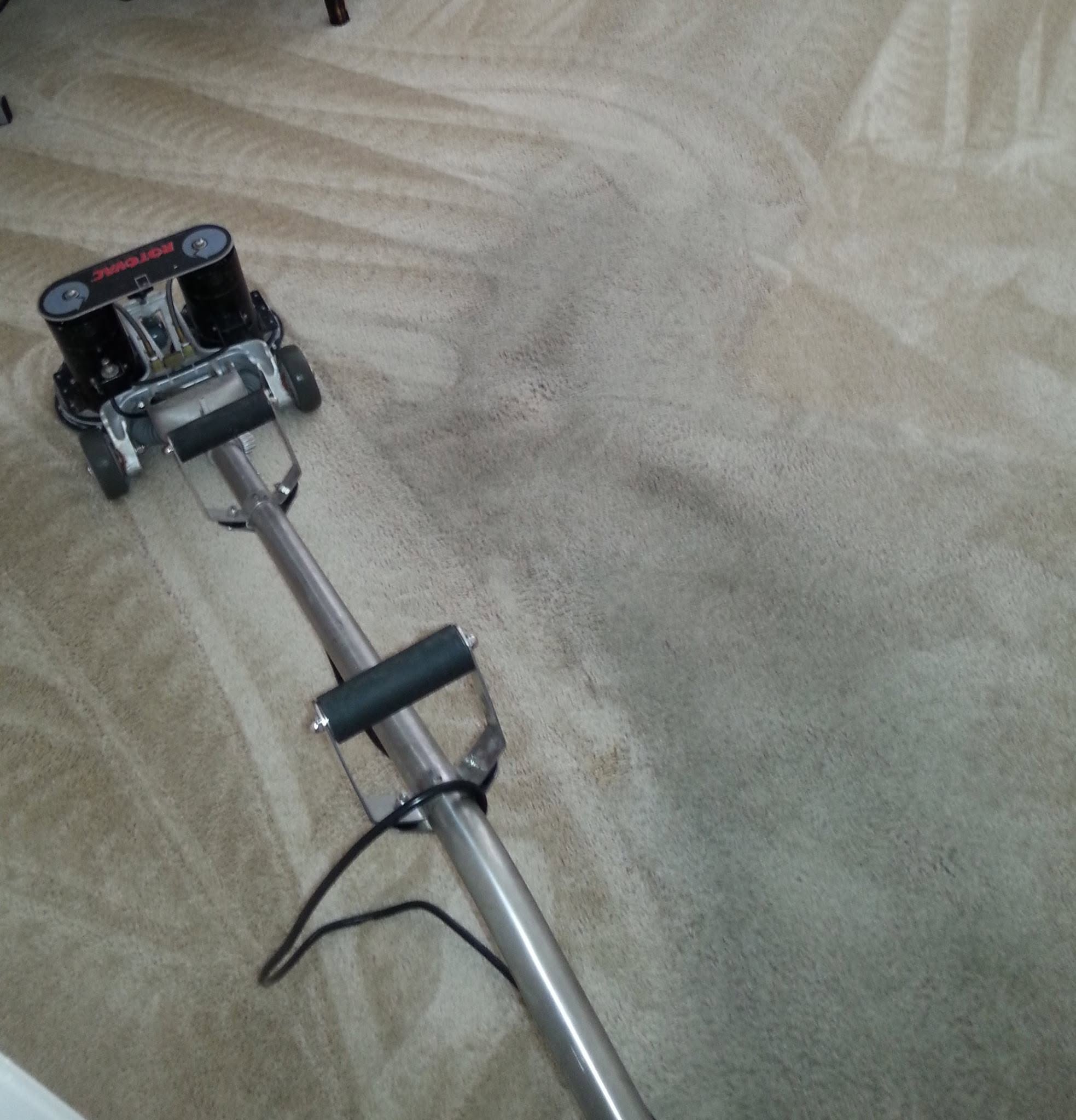
The machine you see in this photo is a Rotovac 360i — a rotary extraction tool that is a core part of our patent pending cleaning process. Understanding why we use this equipment — and how it differs from the standard cleaning wand used by most companies — helps explain why our results are consistently better.
Standard cleaning wand: A standard carpet cleaning wand is a straight metal tool that the technician pushes and pulls across the carpet in overlapping strokes. The cleaning jets spray solution forward, and the vacuum slot behind them extracts it. The cleaning action is linear — the solution hits the fiber from one direction, and the extraction pulls it back out from one direction.
The problem with a standard wand is coverage and agitation. The cleaning jets hit the top of the carpet fiber, and the extraction pulls from the top. Soil that is embedded deep in the fiber — down near the backing — may be loosened but not fully extracted. The linear motion also means that the cleaning action is not uniform across the fiber — some areas get more contact than others.
The Rotovac 360i: The Rotovac uses a rotating head with multiple cleaning jets that spin continuously as the tool moves across the carpet. Instead of hitting each fiber from one direction, the rotating jets hit it from 360 degrees — from every angle, continuously, as the head passes over it. This multi-directional agitation is dramatically more effective at dislodging embedded soil from deep in the fiber.
The results are visible in the photo — those geometric patterns in the carpet are the tracks left by the rotating head, and they are a visual record of the thorough, uniform coverage the tool provides. Every fiber in that carpet has been agitated and extracted from multiple directions.
Combined with our neutralized, residue-free chemistry and our carpet protector reapplication protocol, the Rotovac is part of a complete system designed to clean carpet as thoroughly as it can be cleaned — not just make it look clean.
How to Identify a Chemical-Heavy, Non-Neutralized Cleaning — Before You Book
You should not have to take a carpet cleaning company's word for it that their chemistry is safe. Here are the questions to ask and the signs to watch for:
Questions to ask before booking:
-
"What is the pH of your cleaning solution, and do you neutralize after cleaning?" A company that uses neutralized chemistry will know exactly what this question means and will answer it confidently. A company that does not neutralize will either not know what you are asking or will give a vague non-answer.
-
"Do your cleaning solutions contain optical brighteners?" Again, a company with a genuine commitment to safe chemistry will know the answer immediately. If they do not know what optical brighteners are, that tells you something important.
-
"Are your solutions safe for pets and children immediately after drying?" The correct answer is yes — if the chemistry is properly neutralized and residue-free. If the answer involves waiting periods, ventilating the house, or keeping pets off the carpet for extended periods, the chemistry is not safe.
-
"Do you offer carpet protector reapplication?" Any professional company should offer this. If they do not, ask why.
-
"Do you use truck-mounted equipment?" Truck-mounted systems generate significantly more heat and suction than portable units, which means better cleaning and better extraction of both soil and cleaning solution.
Signs of a chemical-heavy cleaning after the fact:
- Rapid re-soiling — If your carpet looks dirty again within weeks of cleaning, alkaline residue is almost certainly the cause. Alkaline residue is sticky and acts as a soil magnet.
- Stiff or crunchy carpet texture — Properly cleaned, neutralized carpet should feel soft. Stiff or crunchy texture is a sign of chemical residue in the fibers.
- Persistent chemical smell — A faint chemical or detergent smell that lingers for days or weeks after cleaning is residue off-gassing.
- Pet behavior changes — Any increase in paw licking, scratching, or skin irritation in pets after a carpet cleaning should be taken seriously.
- Skin reactions in children — Any new rash, irritation, or eczema flare in children after a carpet cleaning warrants investigation.
- Carpet looks "too bright" — If your carpet looks noticeably brighter or more vivid after cleaning than it did when it was new, optical brighteners are likely responsible.
The Annual Cleaning Schedule: Protecting Your Investment and Your Warranty
We have covered why the chemistry matters. Now let's talk about frequency — because even the best cleaning chemistry cannot compensate for a carpet that is cleaned too infrequently.
Why Annual Cleaning Is the Minimum
Carpet is a filter. It traps and holds airborne particles — dust, pollen, pet dander, mold spores, bacteria, skin cells, and more — in its fibers. This is actually one of carpet's benefits: it removes these particles from the air you breathe and holds them until they can be removed by vacuuming and professional cleaning.
But carpet has a finite capacity. When it is full — when the fibers are saturated with trapped particles — it stops filtering and starts releasing. Particles that were trapped in the fiber get dislodged by foot traffic and become airborne again. The carpet that was protecting your air quality is now degrading it.
Annual professional cleaning resets the filter. It removes the accumulated particles, restores the carpet's ability to trap new ones, and maintains the indoor air quality benefit that carpet provides.
Beyond air quality, annual cleaning:
- Removes abrasive soil particles that cut carpet fibers with every footstep, causing premature wear
- Removes bacteria and allergens that accumulate in carpet over time
- Maintains the carpet protector (with reapplication) that protects against staining
- Satisfies most carpet warranty cleaning frequency requirements
- Extends the life of the carpet — properly maintained carpet lasts significantly longer than neglected carpet
Recommended Cleaning Frequency by Household Type
| Household Type | Minimum Frequency | Recommended Frequency |
|---|---|---|
| Single adult, no pets | Every 18 months | Annually |
| Couple, no pets | Every 12–18 months | Annually |
| Family with children | Annually | Every 6–9 months |
| Household with pets | Annually | Every 6 months |
| Household with pets and children | Every 6 months | Every 4–6 months |
| Allergy or asthma sufferers | Annually | Every 6 months |
| High-traffic commercial areas | Every 6 months | Quarterly |
Note that these are minimums for maintaining carpet health and warranty coverage. High-traffic areas, households with young children who spend significant time on the floor, and households with multiple pets may benefit from more frequent cleaning.
The True Cost of Infrequent Cleaning
Homeowners sometimes delay professional cleaning to save money. This is understandable, but it is a false economy. Here is the math:
- Professional carpet cleaning for a typical Colorado Springs home: $150–$350
- Cost of replacing carpet in a typical Colorado Springs home: $3,000–$8,000+
- Carpet that is properly maintained with annual cleaning and protector reapplication: lasts 15–20 years
- Carpet that is neglected: may need replacement in 7–10 years
The difference in carpet lifespan between properly maintained and neglected carpet can easily represent $3,000–$5,000 in replacement costs. Annual cleaning at $200–$300 per year is an investment that pays for itself many times over.
What a Truly Safe, Professional Carpet Cleaning Looks Like
For comparison, here is what the complete, correct carpet cleaning process looks like — the standard we hold ourselves to at Absolute Floors & More:
1. Pre-inspection We walk the carpet with you, identify problem areas, note any stains or damage, and discuss your concerns. We check the carpet type and fiber content, which determines the appropriate chemistry.
2. Pre-vacuuming Dry soil removal before any moisture is introduced. This step removes the loose, dry particles that would otherwise turn to mud when wet, and it dramatically improves the effectiveness of the wet cleaning process.
3. Pre-treatment Problem areas — high-traffic zones, stains, pet spots — are pre-treated with appropriate chemistry. We use the minimum effective concentration of the safest effective chemistry for each situation.
4. Agitation with rotary extraction Our Rotovac rotary extraction tool agitates the carpet from 360 degrees while simultaneously extracting the loosened soil. This multi-directional agitation is the core of our patent pending process and the reason our results consistently exceed what standard wand cleaning can achieve.
5. Neutralizing rinse After the cleaning pass, we apply a pH-balanced acidic rinse that neutralizes the alkaline cleaning chemistry and brings the carpet back to its natural pH range. This step is non-negotiable. It is what makes our cleaning safe for your children and pets.
6. Spot treatment Any remaining spots or stains are addressed individually with targeted chemistry appropriate to the specific stain type.
7. Carpet protector application We apply professional-grade carpet protector to clean, open fibers, restoring the stain resistance that was removed during cleaning.
8. Grooming The carpet is groomed with a carpet rake to lift the pile, ensure even protector distribution, and speed drying.
9. Final inspection We walk the carpet with you again, confirm that all areas have been addressed, and show you the results.
The entire process takes longer than a standard cleaning. It costs more than a standard cleaning. And it produces results — in cleanliness, safety, and carpet longevity — that a standard cleaning cannot match.
Why We Have Never Compromised on Chemistry
I want to close this article the way I started it — with honesty.
I have been offered cheaper chemical options throughout my career. I have been told by suppliers that customers cannot tell the difference, that the optical brighteners make the carpet look great, that the alkaline residue is not really a problem, that nobody is going to test the pH of their carpet.
I have never taken that path. Not once in 23 years.
Because I have seen what the wrong chemistry does. I have seen the dogs chewing their paws. I have seen the children with rashes. I have seen the carpets that re-soiled in three weeks because nobody neutralized the cleaning solution. I have seen the families who spent money on a cleaning that made their home less safe, not more.
The chemistry I use costs more. The process I use takes longer. The equipment I use requires more investment and more maintenance. But when I leave a home, I know that the carpet is genuinely clean, genuinely safe, and genuinely protected. I know that the children who play on that floor and the pets who sleep on it are not being exposed to chemical residue that I left behind.
That is not a marketing position. It is a personal commitment that I have held for over two decades, and it is the reason that the families I serve keep calling me back — and keep referring their friends.
Schedule Your Safe, Neutralized Carpet Cleaning in Colorado Springs
If you are in Colorado Springs or the surrounding 50-mile radius and you want carpet cleaning done right — with neutralized chemistry, professional-grade carpet protector, and a process that is genuinely safe for your children and pets — give us a call.
Absolute Floors & More LLC
- Phone: (719) 896-6274
- Email: [email protected]
- Request a Free Quote
We serve Colorado Springs, Fountain, Pueblo, Monument, Castle Rock, Woodland Park, and the surrounding region. IICRC Certified. Patent Pending Process. Veteran Owned. Over 23 years of doing this the right way.
Your family deserves clean carpet. Not just carpet that looks clean.
Absolute Floors & More LLC — Colorado Springs, CO — IICRC Certified — Patent Pending Cleaning Process — Veteran Owned
Explore Topics
Written by
Nathaniel Lemieux
Content creator and writer sharing insights and stories.


