
Why Hypoallergenic Carpet Cleaning Doesn't Mean What You Think
Hypoallergenic is a marketing term, not a medical guarantee. Learn why cleaning chemistry, rinsing, extraction, and residue removal matter more.
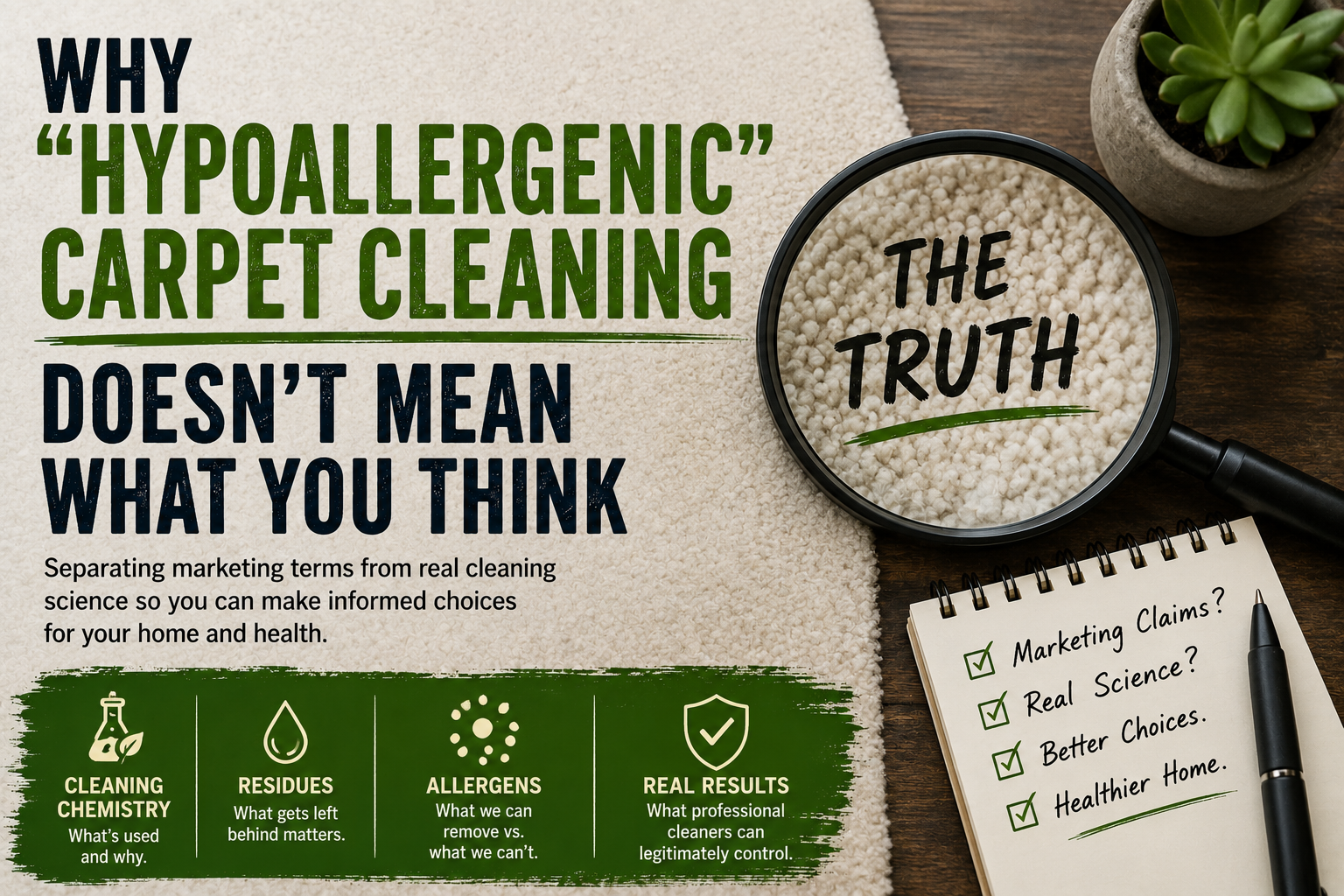
Search for carpet cleaning long enough and you will eventually see the word everywhere: hypoallergenic.
Hypoallergenic carpet cleaning. Hypoallergenic chemicals. Allergy-friendly carpet cleaning. Safe for allergy sufferers. Sometimes the marketing goes even further and makes it sound as though cleaning a carpet can transform a home into an allergen-free environment.
It is a powerful word because it sounds scientific and reassuring. But before choosing a carpet cleaner because they advertise “hypoallergenic carpet cleaning,” there is a more important question to ask:
What exactly do they mean by hypoallergenic?
At Absolute Water Damage & Mitigation and Absolute Floors & More, we believe homeowners deserve a better explanation than a comforting word on a website. Professional carpet cleaning can remove substantial amounts of soil and particulate matter, use appropriate cleaning chemistry, thoroughly rinse carpet, reduce unnecessary residues, and extract moisture effectively.
What we cannot responsibly do is guarantee how an individual immune system will respond to a home after we leave. Those are two completely different things.
Hypoallergenic does not mean allergen-free
People often interpret hypoallergenic as meaning a product contains no allergens or cannot cause an allergic response. That is not what the term reliably tells you.
The U.S. Food and Drug Administration has explained, in the context of cosmetics, that there are no federal standards or definitions governing manufacturers’ use of the term “hypoallergenic.” Carpet-cleaning products are not cosmetics, but the consumer lesson still applies: a marketing word is not the same thing as a measurable guarantee.
Every person is different. Every home is different. Every carpet is different. Every contamination situation is different.
A professional cleaner can explain the process, the products being used, the rinse and extraction approach, and what can reasonably be removed from the carpet. We should not make medical promises, diagnose allergies, or guarantee that a home will be allergen-free.
Four different subjects get mixed into one phrase
A lot of hypoallergenic carpet-cleaning advertising combines several separate issues into one comforting phrase. They should be separated.
We are really talking about at least four things:
- Cleaning chemistry — what is being applied to the carpet.
- Chemical residue — what may remain after cleaning if the process is incomplete.
- Environmental allergens and particles — dust, pollen, pet dander, hair, and other material held by carpet.
- A person’s medical response — an individual health matter that a carpet cleaner cannot predict or control.
A professional carpet cleaner can influence the first three. The fourth belongs in an entirely different category.
Understanding that difference makes it much easier to evaluate what you are actually buying.
Cleaning chemistry: what is being put into the carpet?
Professional carpet cleaning involves chemistry. There is nothing inherently bad about that statement. Water itself is a chemical substance. Depending on the carpet, soil, staining, contamination, and cleaning method, professional cleaners may use detergents, surfactants, builders, solvents, oxidizers, reducers, enzymes, acids, alkaline products, and other formulations.
The better question is not, “Do you use chemicals?” It is:
Are you using the appropriate chemistry, at the appropriate concentration, for this carpet and this contamination?
Using more chemical is not automatically better cleaning. Using less chemical is not automatically safer cleaning. Using something marketed as natural does not automatically mean it cannot irritate someone.
The quality of the process matters.
For sensitive households, fragrance-free carpet cleaning may be an important request. That is reasonable. A professional should be able to discuss whether appropriate fragrance-free options are available for the specific cleaning situation. But fragrance-free and hypoallergenic are not interchangeable claims.
Residue: what gets left behind matters
Imagine washing clothes with detergent and never running the rinse cycle. The detergent may have done an excellent job loosening soil, but you probably would not want all of it remaining in the fabric.
Carpet cleaning follows the same basic principle. Cleaning chemistry helps separate unwanted material from carpet fibers. Then we need to remove it.
That is why thorough carpet rinsing and powerful extraction are so important. The objective is not to soak a carpet with as much product as possible. The objective is to use enough of the correct chemistry to accomplish the cleaning task and then recover suspended soil, contamination, moisture, and unnecessary residues.
For homeowners concerned about chemical sensitivity or cleaning residue, that is a much more useful conversation than simply pointing to the word “hypoallergenic” on a bottle.
Ask about the process:
- What products are being applied?
- Why are those products appropriate for this carpet?
- How are they being rinsed from the carpet?
- What extraction method is used?
- How will the carpet be dried?
- Can fragrance-free chemistry be used when appropriate?
Those questions tell you something real.
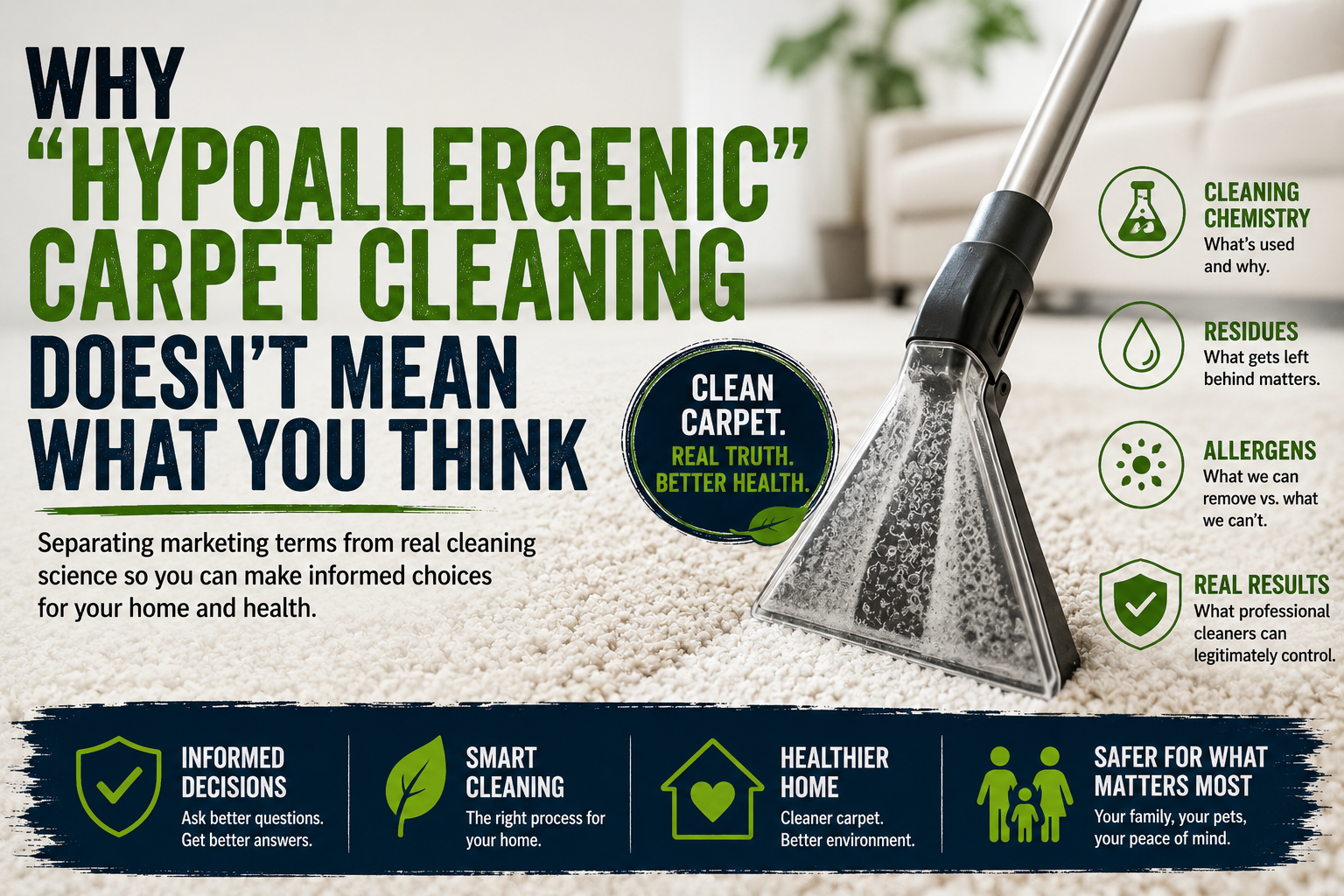
Carpet can hold dust, pollen, pet hair, and dander
Carpet acts as a collection surface. Dust enters the home. People track material inside. Pets shed hair and dander. Pollen comes through doors and windows. Particles settle from the air. Food debris, skin particles, and other materials can accumulate over time.
Some of that material can become embedded below the visible surface of the carpet. Professional hot water extraction carpet cleaning can remove substantial amounts of accumulated soil and particulate matter. That is a legitimate cleaning objective.
But saying we removed material from the carpet is very different from saying, “Your house is now allergen-free.”
No professional carpet cleaner can control every source of allergens inside a home. HVAC systems, furniture, mattresses, curtains, pets, outdoor air, and daily activity all continue to contribute material to the indoor environment.
Carpet cleaning is one component of maintaining a cleaner indoor environment. It is not a medical treatment for the building.
Pet allergens make the limitation easy to understand
Suppose a homeowner has a dog. We professionally clean the carpet and remove a significant amount of accumulated hair, dander, soil, and other material.
Did we improve the cleanliness of the carpet? Yes.
Did we remove material that could include allergens? Yes.
Did we make the home permanently free of dog allergens? No. The dog still lives there, walks across the carpet, sheds again, and contributes new material over time.
That does not mean professional carpet cleaning did not work. It means we should accurately describe what it accomplished.
For homes with pets, children, or allergy-conscious residents, a well-executed cleaning process can be valuable. The honest benefit is a cleaner carpet with reduced accumulated material and unnecessary residue—not a promise that the home is medically allergen-free.
A cleaner can control the process, not your immune system
This may be the most important point in the article:
Professional carpet cleaners can control cleaning procedures. We cannot control someone’s biological response.
We can select appropriate chemistry. We can follow manufacturer dilution instructions. We can avoid unnecessary product application. We can thoroughly rinse. We can perform powerful extraction. We can remove substantial amounts of soil and particulate matter. We can reduce unnecessary residues. We can promote appropriate drying. We can explain what products were used.
Those are legitimate professional responsibilities.
What we should be careful not to do is make medical promises. We should not diagnose allergies, promise that cleaning carpet will prevent allergic reactions, or guarantee that someone with asthma, chemical sensitivities, or another medical condition will not experience symptoms.
“Chemical-free carpet cleaning” can be misleading too
Another phrase often connected to hypoallergenic marketing is chemical-free carpet cleaning. It sounds appealing, but it can create confusion.
If a company is using water, it is already using a chemical substance. Usually, what a company means is something more specific: perhaps no conventional detergent, no added fragrance, no particular solvent, no certain class of cleaning agent, or a process primarily based on water and mechanical extraction.
That can be a useful distinction. But it should be explained clearly.
Consumers deserve specific information instead of vague language designed to sound safer:
- What are you using?
- Why are you using it?
- How much are you applying?
- How are you removing it?
Those questions are more valuable than whether a marketing department found a comforting adjective.
What should an allergy-conscious customer ask a carpet cleaner?
Instead of only asking, “Do you offer hypoallergenic carpet cleaning?” ask better questions:
- What products will you use in my home?
- Are fragrances added?
- Can you use fragrance-free chemistry when appropriate?
- How are cleaning products rinsed from the carpet?
- What extraction method do you use?
- How much moisture do you typically recover?
- How will the carpet be dried?
- Do you recommend thorough vacuuming before wet cleaning?
- Can you provide information about the products being applied?
These questions encourage a company to explain its actual procedure. That is much more valuable than hearing, “Everything we use is hypoallergenic.”
What professional carpet cleaning can honestly promise
We do not need exaggerated health claims to explain the benefits of properly cleaning carpet.
Professional carpet cleaning can:
- Remove accumulated soil and particulate matter.
- Remove pet hair and other debris.
- Address spots and contamination.
- Remove residues left from previous cleaning attempts.
- Improve the appearance and cleanliness of carpet.
- Use carefully selected chemistry.
- Thoroughly rinse and extract that chemistry.
- Leave the carpet cleaner than it was before service.
Those are meaningful benefits. We do not need to turn them into medical guarantees.
There is a major difference between saying, “We use a professional cleaning process designed to thoroughly clean and rinse your carpet while minimizing unnecessary residue,” and saying, “Our carpet cleaning is hypoallergenic.”
The first statement tells you something about the process. The second leaves important questions unanswered.
The bottom line: ask about the process, not the buzzword
If you are concerned about allergies, sensitivities, pets, children, fragrance, or cleaning residues, tell your carpet-cleaning company. Those concerns matter.
But do not let one reassuring marketing word make the decision for you. Ask what is being put into your carpet. Ask why it is being used. Ask how it is being removed. Ask about rinsing, extraction, drying, and fragrance options.
At Absolute Water Damage & Mitigation and Absolute Floors & More, our goal is not to convince homeowners that carpet cleaning can magically create an allergen-free home. Our responsibility is much more practical:
Use the right chemistry. Remove the contamination. Rinse thoroughly. Extract aggressively. Minimize unnecessary residue. Dry the carpet properly. And tell customers the truth about what professional cleaning can and cannot accomplish.
For professional, allergy-conscious carpet cleaning in Colorado Springs, call (719) 896-6274 to discuss your home, your concerns, and the cleaning process that makes sense for your carpet.
Explore Topics
Written by
Nate Lemieux
Content creator and writer sharing insights and stories.


