How Long Should My Carpet Take to Dry? The Real Answers From Decades of Actual Cleaning Experience
The carpet cleaning industry has a drying time problem, and it's time someone told the truth. Most companies advertise 2–4 hour drying times without explaining the countless factors that determine how long a properly cleaned carpet actually takes to dry. Here are the real answers from over two decades of hands-on experience.
The Carpet Cleaning Industry Has a Drying Time Problem — And It's Time Someone Told the Truth
There is so much false and misleading information in the carpet cleaning industry about how long carpets should take to dry after professional cleaning. Unfortunately, many companies continue advertising drying times of just 2 to 4 hours without explaining the countless factors that determine how long a properly cleaned carpet actually takes to dry. At Absolute Floors & More, we have spent decades physically cleaning carpets, working with different materials, constructions, padding, soil conditions, chemicals, and equipment. We are not repeating something we read online or using a marketing pitch to sell a service. We are explaining what we have learned from years of actually doing the work.
Let's start with something the carpet cleaning industry doesn't seem too interested in discussing. Not all carpets are created equally. The quality of the carpet, its thickness, fiber length, density, construction, backing, and the type of padding underneath are all major factors in drying time. Now add the condition of the carpet, how dirty it is, the amount of cleaning required, the indoor temperature, humidity, airflow, outdoor weather conditions, and the cleaning methods being used. Suddenly, the industry's favorite 2-to-4-hour drying-time promise starts looking more like a sales pitch than an honest professional assessment.
Pre-Spraying, Dwell Time, and What Most Companies Skip
One of the biggest red flags we see is companies that do not properly pre-spray carpets before cleaning. A professional deep cleaning should involve applying the appropriate cleaning solution to the carpet and allowing the chemicals sufficient dwell time to break down the dirt, oils, and contamination trapped within the fibers. Most cleaning chemicals, shampoos, and spotters require time to actually work. Simply injecting shampoo through a water line while extracting it almost immediately afterward does not provide the same chemical contact time as a proper pre-treatment. Yet customers are often never told the difference.
What makes this even more concerning is the residue that can be left behind when cleaning solutions are not properly rinsed and extracted. Shampoo residue can attract additional dirt, contribute to rapid resoiling, and leave unwanted chemicals in the carpet where children and pets spend their time. Have you ever wondered why your carpet looked great immediately after cleaning but somehow appeared dirty again a week later? Improper rinsing, leftover cleaning products, and inadequate soil removal are some of the reasons this happens. The customer thinks the carpet was professionally deep cleaned when the reality may be that much of the soil was never properly removed.
Heavily Soiled Carpets Require More — Not Less
Now let's talk about carpets that are actually dirty. A lightly soiled carpet and a heavily contaminated carpet are not going to require the same cleaning process. The dirtier a carpet is, the more attention it may require. That can mean heavier pre-spraying, additional dwell time, mechanical agitation, power scrubbing, multiple extractions, spot treatments, and additional rinsing. Every additional step and the amount of moisture used and recovered can affect how long the carpet takes to dry. Proper cleaning is not about spraying a little shampoo, making a quick pass, collecting a payment, and telling the customer everything will be dry in a couple of hours.
Carpet Thickness, Fiber Length, and Construction
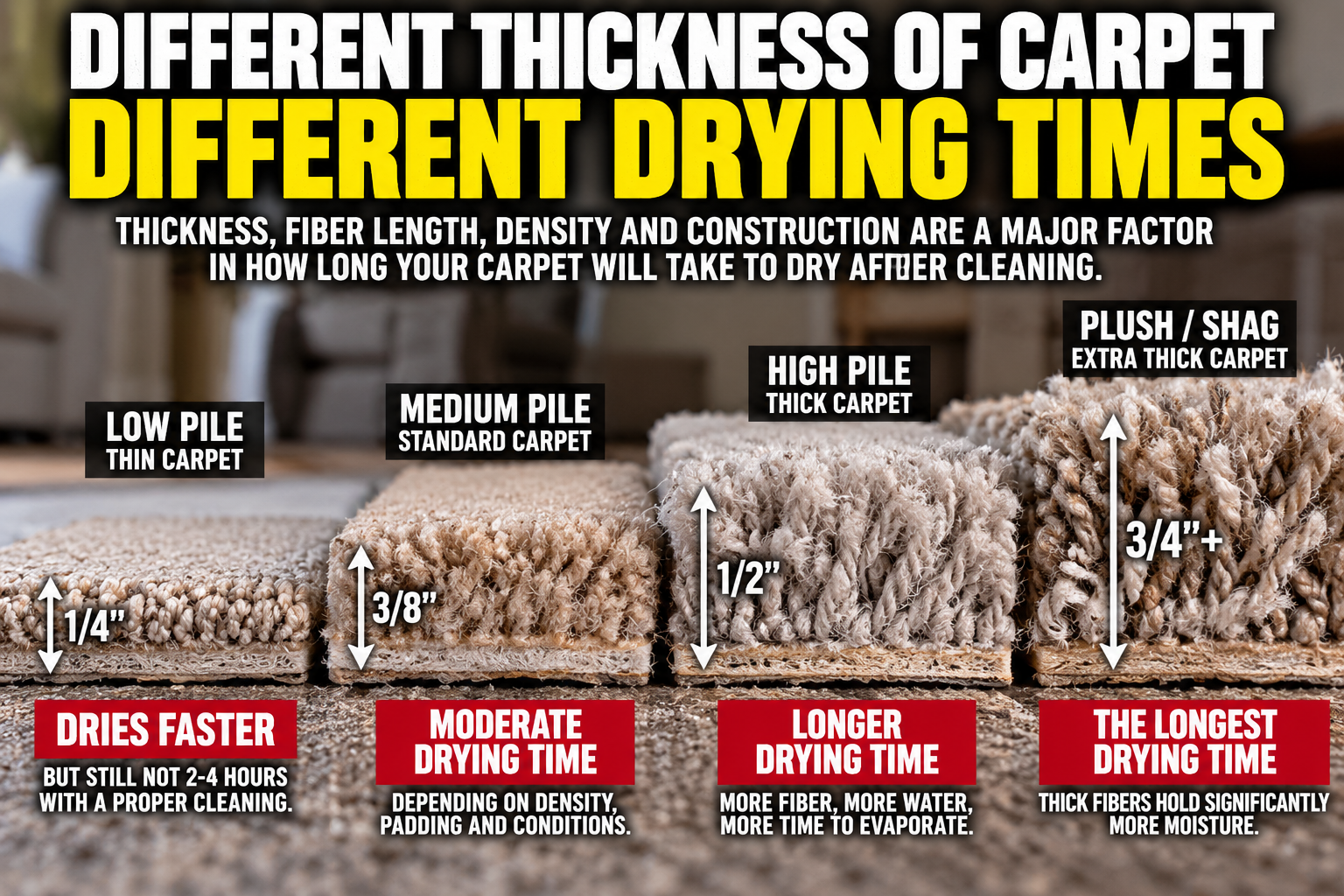
Not all carpets dry at the same rate — and carpet construction is one of the biggest reasons why. Low pile carpet (1/4" fiber height) holds significantly less moisture than plush or shag carpet (3/4" and above). Thicker fibers hold more water, take longer to release it, and require more airflow to dry completely.
Density matters too. A tightly woven, dense carpet traps moisture between fibers and restricts airflow through the pile. A more open construction allows air to move through more freely. The backing material, the density of the weave, and even the fiber type (nylon, polyester, wool, olefin) all affect how quickly moisture evaporates after cleaning.
A technician who quotes the same drying time for a low-pile Berber and a thick plush shag is not giving you an honest assessment — they are giving you a marketing number.
Pet-Proof Padding: The Hidden Factor That Changes Everything
Then there is one of the biggest factors in modern carpet construction that many customers don't even know exists. Pet-proof carpet padding. Many of these pads have a plastic or moisture-resistant barrier across the top. While these barriers are designed to prevent liquid from soaking into the padding, they also change how moisture and air move through the carpet system.
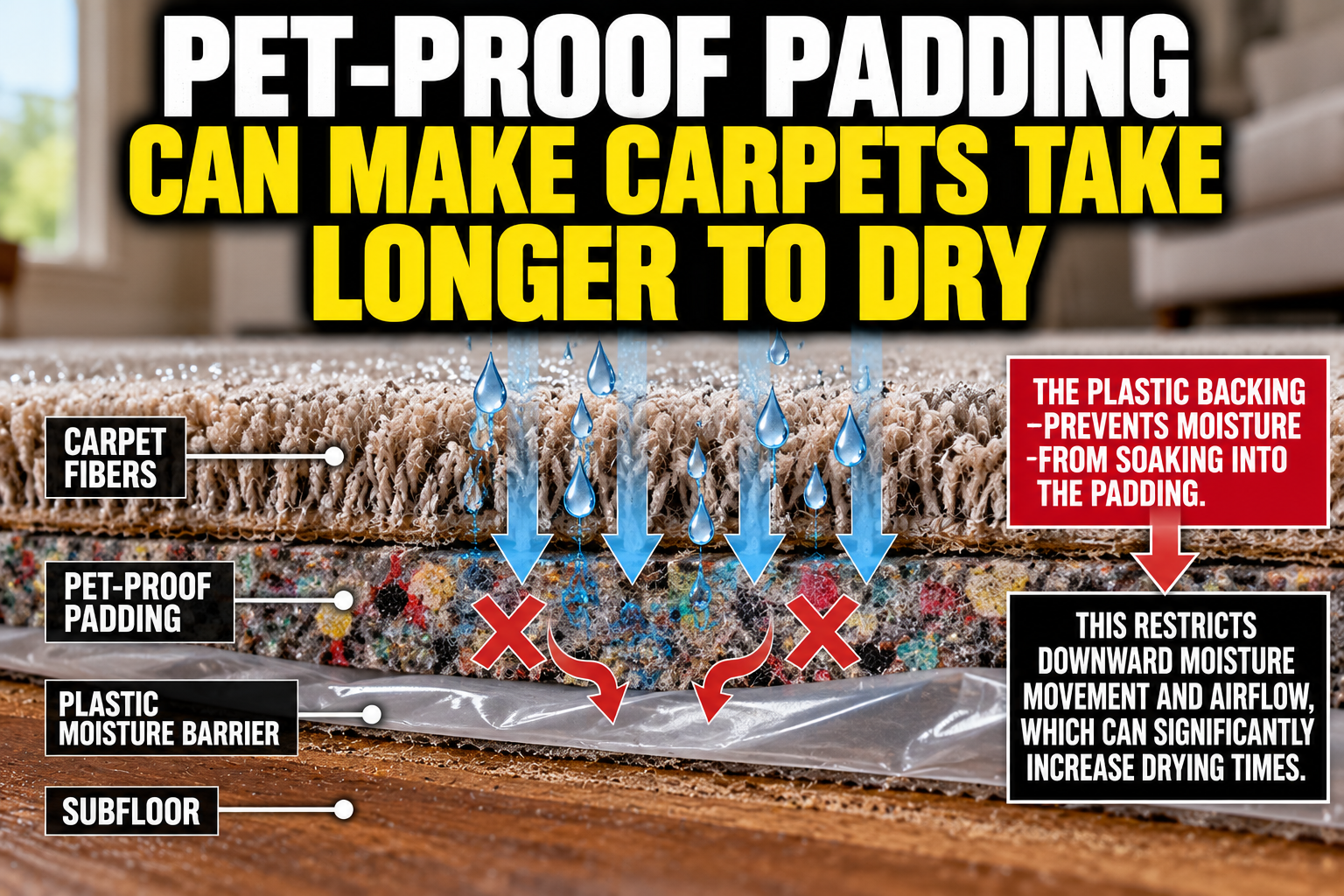
Unlike traditional padding, the barrier restricts downward moisture movement and airflow. Depending on the carpet construction and cleaning conditions, this can dramatically increase drying times — sometimes two or three times longer than expected. A knowledgeable carpet technician should be looking for these conditions and explaining them to the homeowner rather than promising the same drying time for every carpet.
Weather, Humidity, and Home Conditions
Weather and home conditions are another major part of the equation. Indoor temperature, humidity, air circulation, air conditioning, ventilation, and outdoor conditions all affect evaporation. Cool temperatures combined with elevated humidity and poor airflow can significantly extend drying time.
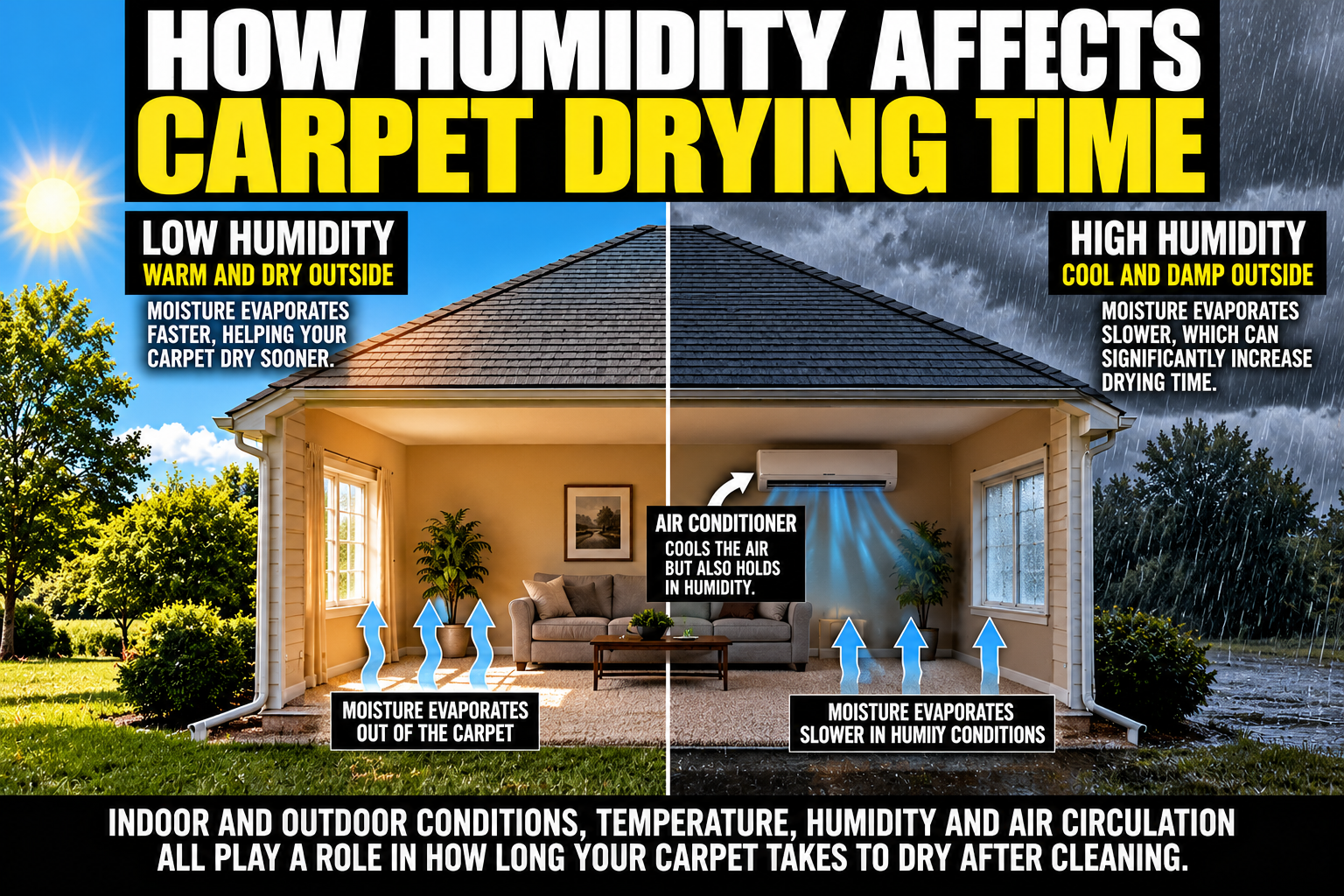
Air conditioning can also affect temperature and moisture conditions inside the home, although a properly functioning system generally removes humidity while operating. During warm, dry weather, opening windows and allowing the carpet to benefit from appropriate ventilation can help moisture evaporate faster. However, when outdoor humidity is high, opening windows may make matters worse.
When humidity is high outside and conditions are cool, you can simply turn up the heat inside your home to help your carpets dry faster. Warmer indoor temperatures help promote evaporation, especially when combined with proper airflow and moisture removal.
There is no universal answer because every home and every cleaning situation is different.
The Honest Answer: 8 to 24 Hours
When you combine the carpet quality, thickness, density, fiber length, padding, soil conditions, cleaning procedures, indoor environment, and outdoor weather, a properly deep-cleaned carpet can take 8 to 24 hours to dry — and sometimes longer. At Absolute Floors & More, we would rather give our customers a realistic expectation than make a drying-time promise simply because it sounds better.
We generally tell our customers to allow approximately 24 hours, and there are several reasons for that recommendation. One of the most important involves moving furniture back onto damp carpeting. Metal furniture legs can leave rust stains, and wooden furniture can transfer varnish, dyes, and other finishes into damp carpet fibers. These stains can become permanent. We would rather have a customer wait longer than risk damaging freshly cleaned carpeting by moving furniture too soon. It is better to be safe than sorry.
The Real Question You Should Be Asking
And this brings us back to the industry's obsession with advertising 2-to-4-hour drying times. We are challenging the practice of presenting that number as though it represents every carpet, every home, and every level of cleaning. From our professional experience, a company that uses minimal moisture, skips proper pre-spraying, provides little or no chemical dwell time, and barely cleans beyond the surface may very well achieve those short drying times. But a fast-drying surface is not proof that the carpet was thoroughly cleaned. We believe customers deserve to know exactly what type of cleaning they are receiving instead of being sold on how quickly the technician can finish.
This industry needs more honesty and fewer marketing gimmicks. A professional carpet cleaner should be knowledgeable enough to inspect the carpet, recognize different materials and padding, understand soil conditions, explain the cleaning process, and discuss the factors that affect drying time. A technician should also have the experience and integrity to tell a customer when a carpet needs additional cleaning, when a stain may return, when damage is permanent, and when drying may take longer than expected. That is what customers are paying a professional to know.
At Absolute Floors & More, we don't have time for shortcuts, improper carpet cleaning, misleading promises, or the bad reviews that come from doing a job incorrectly. Our standards are based on proper pre-treatment, appropriate dwell time, thorough soil extraction, and honest communication with every customer.
The carpet cleaning industry has spent years teaching customers to ask how fast their carpet will dry. We believe customers should be asking a much more important question.
How thoroughly was my carpet actually cleaned?
Because a carpet that dries quickly is not necessarily a carpet that was cleaned correctly. And a carpet that takes longer to dry is not automatically a sign that something went wrong.
There is a difference between cleaning the surface of a carpet and performing a thorough professional deep cleaning. Customers deserve to know that difference.
That's the real answer to the question, "How long should my carpet take to dry after professional cleaning?"
And it's time the carpet cleaning industry started explaining the entire process instead of selling customers a number.
Absolute Floors & More. Real knowledge, real experience, and professional cleaning without the shortcuts.
Explore Topics
Written by
Absolute Floors & More
Content creator and writer sharing insights and stories.