
The EPA, Your Air Ducts, and Nearly 30 Years of Hands-On Experience. The Truth the Industry Isn't Telling You.
There has been an alarming amount of misinformation circulating about professional air duct cleaning, particularly concerning what the EPA has supposedly said. The EPA never told homeowners to stop cleaning their air ducts. Here is the truth from nearly 30 years of actually working inside these systems.
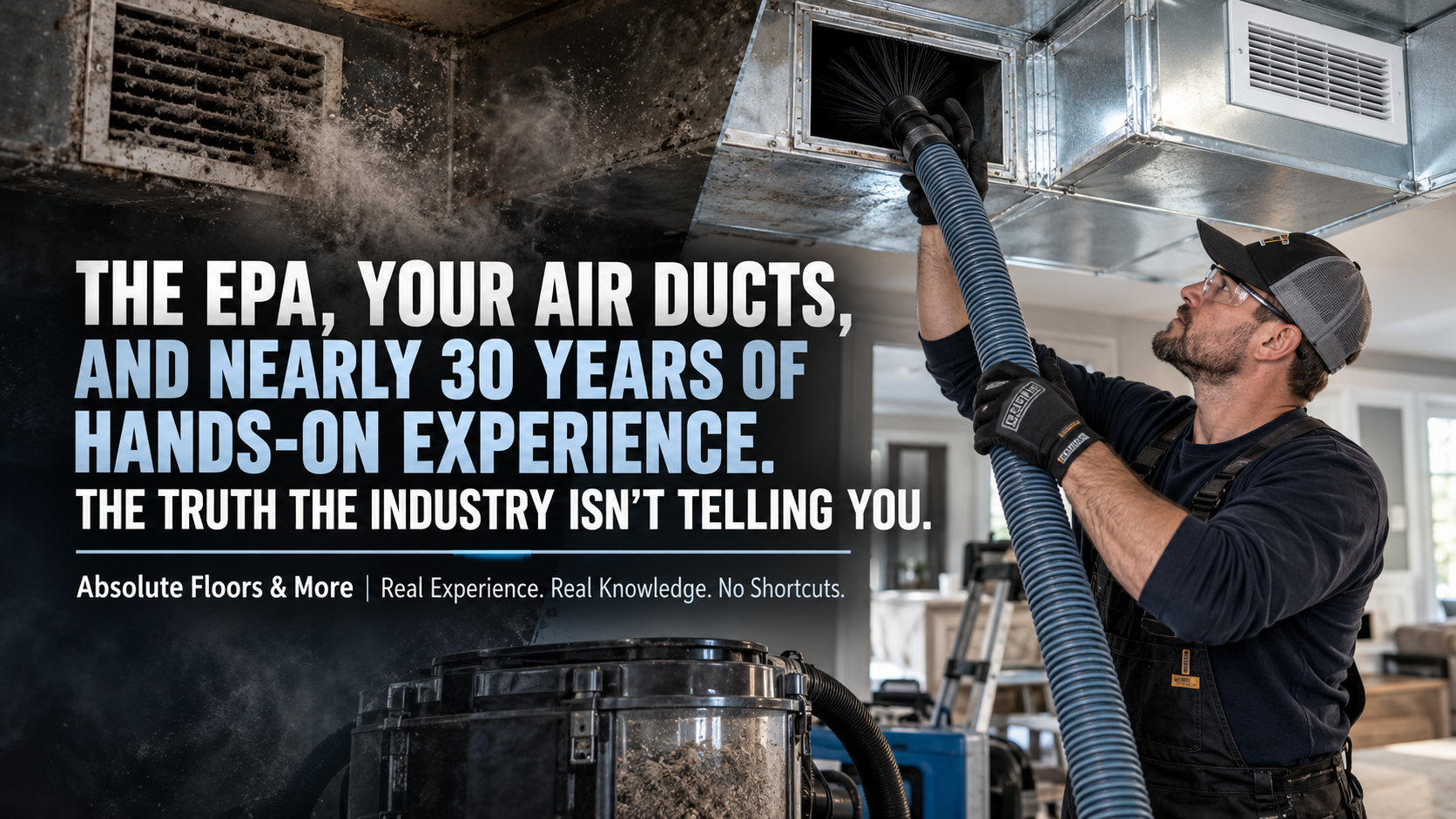
The EPA, Your Air Ducts, and Nearly 30 Years of Hands-On Experience
There has been an alarming amount of misinformation circulating about professional air duct cleaning, particularly concerning what the Environmental Protection Agency has supposedly said about the industry. We are seeing homeowners repeat claims that the EPA recommends never having air ducts cleaned, that duct cleaning provides no benefits, and that dust accumulating inside ventilation systems is somehow nothing to worry about. Let's correct something immediately. The EPA never said homeowners should never clean their air ducts. That is simply false.
The EPA published information in October 1997 explaining that research into the overall health benefits of air duct cleaning was limited. The agency did not issue a blanket prohibition against cleaning. In fact, its own guidance specifically identifies excessive dust and debris being released into living spaces, pest infestations, and substantial visible mold contamination as reasons homeowners should consider having their systems cleaned. Unfortunately, people have taken selected statements from that publication and turned them into something entirely different.
What troubles me about some of this information is the enormous difference between studying something under controlled circumstances and physically working inside these systems for decades. Research is important, but so is the knowledge accumulated through actual field experience. A lack of conclusive studies proving that every household benefits from duct cleaning does not mean that removing significant contamination serves no purpose.
Nearly 30 Years Inside These Systems
I have personally been cleaning air ducts for almost three decades. I have seen just about everything this industry has to offer. I have worked with enormous truck-mounted vacuum systems, RotoVac equipment, portable cleaning systems, brushes, agitation equipment, and numerous other methods. I have also witnessed people show up with little more than an air hose connected to a compressor or generator setup on the back of a truck, blowing debris around while attempting to collect it with a shop vacuum. Believe me, there is an enormous difference between owning equipment and actually knowing how to clean an air duct system.
The Biggest Truck Does Not Mean the Best Cleaning
One of the biggest misconceptions in this industry is that having the largest vacuum truck automatically means a company provides the best cleaning. Some of these trucks are impressive. They are enormous, expensive, powerful machines, and they certainly have their place in professional duct cleaning. But bigger equipment does not automatically mean better results.
I have witnessed cleaning operations where debris was pushed farther into duct runs while the company relied on a large vacuum connected near the furnace to supposedly collect everything. Think about that for a moment. A three-story home, multiple duct runs, turns, branches, restricted passages, accumulated debris, and a company promising that everything is being pulled out from one central location.
Read that again. A three-story home.
Now, it is absolutely possible to use powerful negative-pressure equipment successfully in a multistory building. The problem is assuming that suction alone will magically remove everything from every corner, branch, and interior surface. It does not work that way. Dust and debris can adhere to surfaces, collect around bends, settle in low spots, or become trapped in areas that require direct mechanical agitation and additional access. The number of floors is not what determines whether cleaning is successful. The actual cleaning procedures do.
A powerful truck can create negative pressure, but negative pressure is only part of the process. You still have to physically dislodge the accumulated material, control where it travels, and collect it properly. Otherwise, you risk moving debris around instead of removing it. You can have the most expensive machine in the world sitting in someone's driveway, but if the technician does not understand the duct layout, airflow, collection method, and cleaning equipment, that machine is not going to compensate for poor workmanship.
Called In to Redo Other Companies' Work
Over the years, I have been called into numerous homes to redo air duct cleanings performed by high-profile, well-known companies. These were not necessarily inexperienced businesses operating out of someone's garage. Some were established names with impressive equipment and professional advertising. Yet the customers knew something was wrong. They had paid for a supposedly thorough cleaning, but something did not seem right, and they wanted another opinion.
When I inspected these systems, I found situations where significant debris remained after the original cleaning. That is something you cannot explain away with a fancy truck, a company logo, or a brochure describing how powerful your equipment is. If substantial material remains in accessible areas that were supposed to be cleaned, the customer did not receive the results they were promised.
I still use an old-school, hands-on approach because I have learned through decades of experience that physically addressing the contaminated areas, using appropriate agitation and collection methods, and paying attention to individual duct runs produce results that I trust. I am not interested in how impressive a machine looks from the street. I am interested in what comes out of the ductwork and what condition I leave the accessible system in when the job is finished.
What No Company Can Honestly Promise
And here is another reality the industry needs to discuss more openly. No company can honestly promise that it has personally cleaned and verified every single inch of concealed ductwork in every home without having appropriate access to those areas. Some duct systems are hidden behind ceilings, inside walls, and through structural cavities. Certain sections are difficult to reach or inspect, and some installations make complete access impractical without additional openings or even construction work.
Professional cleaning standards provide methods for inspection, access, cleaning, and verification. That does not mean a technician has the ability to see through walls or guarantee the condition of every concealed surface. A company should be able to explain what it cleaned, how it cleaned it, and how it verified the results. There is a tremendous difference between delivering a properly performed professional cleaning and promising an impossible level of certainty about areas nobody has actually inspected.
That is why I refuse to pretend that any machine, company, or cleaning method is magic. Good results come from experience, understanding the equipment, inspecting the system, working methodically, and being honest about limitations.
The Health Side of the Conversation
Now, let's discuss the health side of this conversation, because this is where the EPA's statements are repeatedly misunderstood.
The EPA has stated that duct cleaning has not been conclusively demonstrated to prevent health problems. That is not the same thing as proving that contamination inside ductwork cannot contribute to indoor environmental problems. The agency itself acknowledges that heavily contaminated ducts can distribute pollutants throughout a home and that certain contaminants may contribute to allergic reactions or other symptoms when people are exposed to them.
I have seen the human side of this firsthand. Over the years, I have encountered customers struggling with allergies, irritation, and other symptoms. Those are real experiences from my career, and I am not going to pretend I did not witness them simply because a government publication says the scientific evidence is inconclusive. However, I also understand that an improvement following cleaning does not automatically prove that the cleaning was the sole cause. Allergies are complicated, and many different environmental factors can contribute to symptoms.
What I can say is that I have seen improvements that were meaningful to the people experiencing them, and those observations are part of why I take indoor contamination seriously.
I have witnessed similar changes in my own home. After cleaning my duct system, I noticed what appeared to be a dramatic reduction in the amount of dust accumulating around the house, roughly half of what I had previously been experiencing. That was my personal observation, not a laboratory measurement, but it was noticeable enough that I remember the difference.
Does that mean every home will experience the same results? Of course not. Homes have different ventilation systems, filtration, occupancy, flooring, pets, outdoor conditions, construction materials, and sources of airborne particles. Cleaning dirty ductwork cannot eliminate every source of household dust. But that is no reason to dismiss legitimate improvements people have observed.
Dust is also not some harmless material that should automatically be ignored. Depending on its composition, household dust can contain allergens, fine particles, pet dander, pollen, and other substances capable of affecting sensitive individuals. The question is not whether every speck of dust is dangerous. The question is whether a particular system contains enough contamination, and whether that contamination is capable of reaching occupied spaces, to justify professional attention.
Another problem with the industry's reputation is that some companies have made exaggerated promises about the health benefits of cleaning. No responsible professional should guarantee that duct cleaning will cure allergies, eliminate asthma, or prevent illness. That is not a realistic or defensible promise. But the opposite claim, that cleaning substantial contamination can never help anyone, is equally unreasonable.
We need to stop pretending the only choices are either miraculous health benefits or absolutely no benefits at all. The real world is far more complicated.
Our Maintenance Recommendation
At Absolute Floors & More, we believe that air duct systems should be evaluated and maintained just like other parts of a home. We generally recommend considering professional air duct cleaning approximately every three to five years, depending on the household's actual conditions. That is our experience-based maintenance recommendation, not a universal EPA requirement or a guarantee that every home needs cleaning on that schedule.
A home with multiple pets, excessive shedding, significant foot traffic, recent construction, renovation debris, or neglected air filters may need attention sooner. A well-maintained home with a properly operating HVAC system, effective filtration, and minimal contamination may go longer between cleanings. Those distinctions matter.
One of the most important things homeowners can do is regularly inspect and replace their air filters. A filter that is clogged, incorrectly sized, poorly fitted, or neglected can allow unwanted particles to accumulate or interfere with proper airflow. And even a well-maintained filter does not address every source of contamination, particularly dirt entering through leaks or debris already inside the system.
Don't Overlook Your Dryer Vent
We also strongly encourage homeowners to understand the difference between their HVAC air ducts and their clothes dryer exhaust vents. These are two entirely different maintenance concerns.
Dryer vents need regular inspection and cleaning because lint buildup can restrict airflow, reduce drying performance, increase operating temperatures, and contribute to a serious fire hazard. Our advice is not to let dryer vent maintenance go beyond two years, and annual cleaning is the safer general recommendation. Heavy dryer use, long vent runs, multiple bends, or noticeable lint accumulation may justify cleaning even more frequently. The lint screen should also be cleaned after every load.
Unlike the debate over the universal health benefits of HVAC duct cleaning, the fire danger associated with neglected dryer exhaust systems is well established. This is one service homeowners should never overlook.
The Truth Is Found Inside the Ductwork
Ultimately, the issue is not whether an enormous truck, a portable vacuum, or a particular brand of cleaning equipment is the best. It is whether the company knows how to use its equipment correctly, understands the system it is working on, and actually removes the accumulated material rather than simply moving it around.
After almost three decades in this industry, I have learned that the truth is usually found inside the ductwork, not in the advertising.
I have seen expensive machines produce disappointing results. I have seen neglected systems holding substantial amounts of contamination. I have been hired to correct previous cleanings that should have been performed properly the first time. And I have witnessed homeowners report meaningful improvements after their systems were thoroughly cleaned.
Those experiences do not replace scientific research, but neither should practical experience be discarded simply because a publication has not established a universal outcome for every household.
The EPA never told everyone to stop cleaning their air ducts. It cautioned against unnecessary cleaning and unsupported health claims while recognizing legitimate situations where duct cleaning should be considered. There is an important difference.
At Absolute Floors & More, our position is straightforward. Know what is inside your system. Maintain your filters. Understand the conditions in your home. Have your ductwork inspected and professionally cleaned when justified. And most importantly, hire someone who knows how to physically remove contamination instead of simply selling you the biggest machine or the most impressive promise.
We will continue relying on decades of hands-on knowledge, actual results, and honest assessments rather than repeating misleading information circulating online.
A clean-looking vent does not prove you have clean ductwork. A massive vacuum truck does not guarantee a thorough cleaning. And nearly 30 years of working inside these systems has taught me something no advertisement ever could.
The equipment is only as good as the person operating it.
Absolute Floors & More. Real Knowledge. Real Experience. No Shortcuts.
Explore Topics
Written by
Absolute Floors & More
Content creator and writer sharing insights and stories.


