
Are Renters Responsible for Move-Out Cleanings Under the New Colorado Law?
YES! A growing public narrative says tenants do not have to clean on move-out. That is legally inaccurate. Here is a full breakdown of what Colorado law actually requires.

The New Renter Law and How It Works
Are Renters Responsible for Move-Out Cleanings? YES!
Here is a write-up we have done to give a clear understanding about what this new law does.
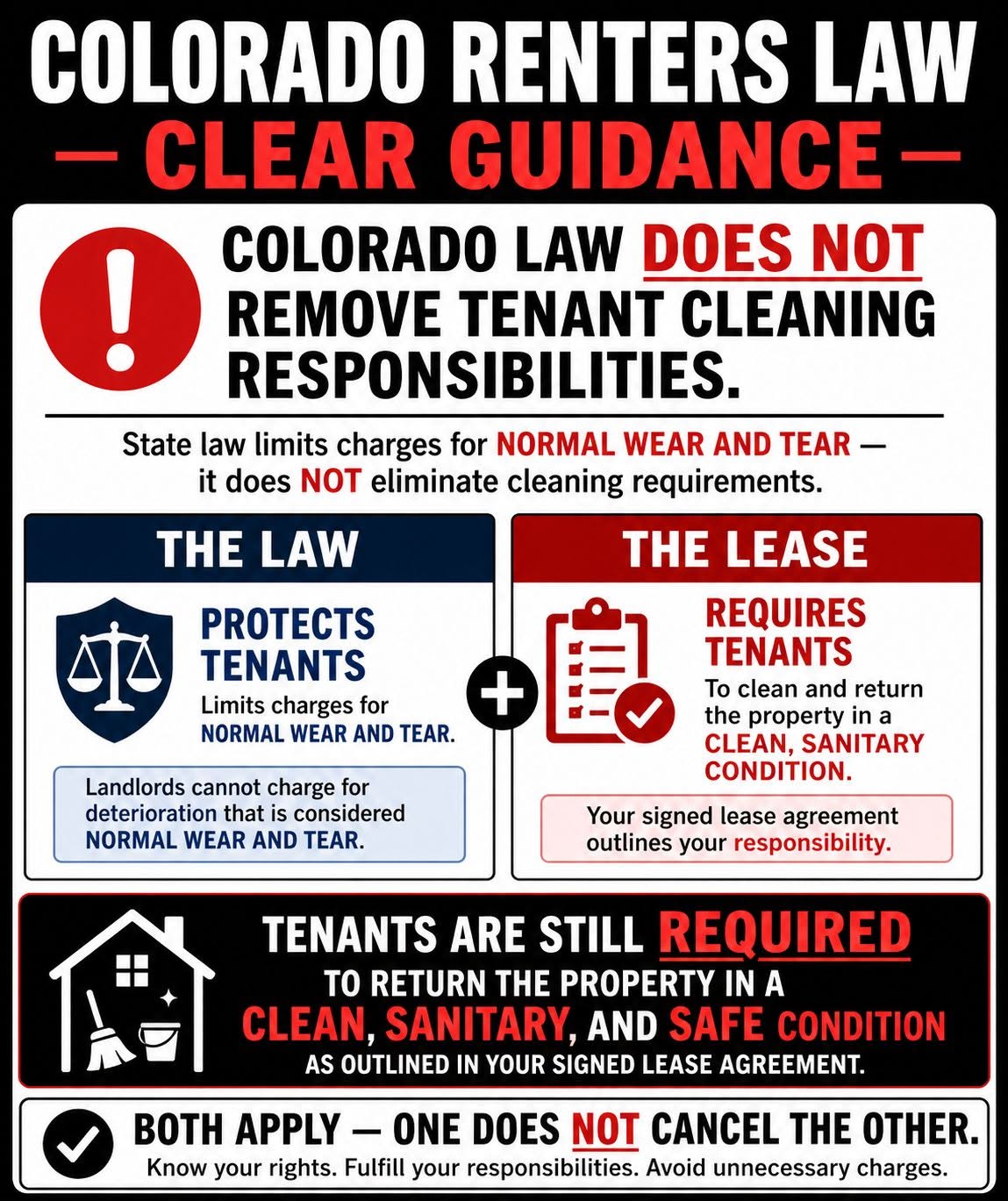
FORMAL LEGAL STATEMENT AND ANALYSIS
Regarding Tenant Cleaning Obligations Under Colorado Law, Contractual Duties, and Associated Public Health, Safety, and Liability Risks.
I. Introductory Statement and Purpose
This document constitutes a formal legal analysis addressing the widespread misinterpretation of residential landlord-tenant law within the State of Colorado, specifically concerning tenant obligations to clean rental premises upon termination of occupancy.
A growing public narrative asserts that tenants are not required to clean rental properties upon vacating. This assertion is legally inaccurate, materially misleading, and creates substantial risks to public health, housing standards, contractual enforcement, and liability allocation.
Colorado law does not eliminate tenant cleaning obligations. Rather, it limits the ability of landlords to impose automatic or unjustified cleaning charges for conditions attributable solely to ordinary wear and tear. These statutory protections do not relieve tenants of their obligation to return leased premises in a clean, sanitary, and safe condition.
II. Statutory Framework
Pursuant to Colorado Revised Statutes § 38-12-103, landlords retain the legal right to withhold from a tenant's security deposit reasonable amounts necessary to restore the premises where:
- The property is returned in a condition materially less clean than at the commencement of the tenancy;
- Damage, contamination, or neglect exceeds ordinary wear and tear; or
- Cleaning or remediation is reasonably required to restore sanitary and habitable conditions.
The statute does not prohibit cleaning charges; it restricts unreasonable or automatic charges. Properly applied, the law preserves both tenant protections and landlord rights.
III. Contractual Obligations Under Lease Agreements
In addition to statutory duties, tenants are independently bound by the terms of their executed lease agreements, which constitute legally enforceable contracts.
Standard residential lease agreements in Colorado routinely impose affirmative obligations requiring tenants to:
- Maintain the premises in a clean, sanitary, and safe condition throughout the tenancy;
- Prevent accumulation of waste, debris, contaminants, or hazardous materials;
- Use the premises in a manner consistent with health and safety standards;
- Return the premises in substantially the same condition as received, excluding ordinary wear and tear;
- Perform or pay for reasonable cleaning upon vacating.
Failure to comply with these contractual provisions may constitute:
- Breach of contract;
- Grounds for lawful security deposit deductions;
- Liability for damages, remediation costs, or professional cleaning services.
Accordingly, tenant cleaning obligations arise from both statutory law and binding contractual agreements and cannot be disregarded based on misinterpretations of limited statutory protections.
IV. Sanitation and Condition of Premises
A residential rental property does not remain in its original condition following occupancy. Ordinary human use inherently introduces:
- Dirt, oils, and organic residue;
- Skin cells, hair, and biological particulates;
- Food waste and debris;
- Bacteria, viruses, and microbial contaminants;
- Allergens, pet dander, and environmental pollutants.
A move-out cleaning requirement is therefore not punitive in nature but constitutes a baseline sanitation standard consistent with habitability requirements, public health considerations, and reasonable property maintenance expectations.
V. Whole-Property Cleaning Standard
Contamination within a residential property is not confined to isolated areas but is distributed throughout the premises due to normal occupancy.
This includes:
- Airborne particulates and aerosolized contaminants;
- Surface contamination from repeated human contact;
- Embedded materials in carpets, flooring, and porous surfaces;
- Residual matter in kitchens, bathrooms, and living spaces.
Soft materials such as carpeting and upholstery function as reservoirs for contaminants, retaining moisture, allergens, and microorganisms.
Accordingly, the applicable standard is as follows:
The entire rental property — including all rooms, surfaces, fixtures, flooring, and materials — must be comprehensively cleaned upon vacancy.
Partial or selective cleaning is insufficient to restore sanitary conditions and may result in continued exposure to contaminants.
VI. HVAC Systems, Vents, and Non-Visible Contamination
Residential sanitation extends beyond visible surfaces. Properties operate as integrated systems in which contaminants circulate through:
- Heating, ventilation, and air conditioning (HVAC) systems;
- Air ducts, vents, and returns;
- Dryer vent systems, which accumulate lint and particulate matter.
Where excessive buildup, misuse, or neglect is present, failure to address these systems may result in:
- Reduced indoor air quality;
- Respiratory irritation or illness;
- Elevated fire risk associated with clogged dryer vents.
Reasonable cleaning obligations may therefore include attention to such systems where conditions warrant.
VII. Hazardous Substances and Contamination Risks
An additional risk arises from the potential presence of hazardous substances within rental properties.
Where contamination has occurred, residual hazards may include:
- Drug-related contaminants (e.g., methamphetamine residue);
- Synthetic opioid contamination (including fentanyl);
- Chemical byproducts and toxic particulates;
- Hazardous residues embedded in porous materials.
Such contaminants are frequently not visible and may persist after occupancy, often requiring specialized remediation.
Failure to properly address such contamination may expose subsequent tenants, property owners and managers, and maintenance personnel and contractors to serious health risks and potential legal liability.
VIII. Liability, Negligence, and Risk Allocation
Failure to restore a rental property to a clean and sanitary condition upon termination of tenancy creates measurable legal exposure and shifts liability risk.
Potential consequences include:
- Claims of negligence arising from unsafe or unsanitary conditions;
- Breach of lease agreement;
- Disputes over security deposit deductions;
- Increased remediation costs and delayed occupancy;
- Claims related to failure to disclose hazardous conditions.
A system that minimizes tenant accountability does not eliminate the problem — it transfers the burden to landlords, future occupants, and third-party service providers.
IX. Practical and Systemic Consequences
Misinterpretation of tenant cleaning obligations produces inherent contradictions and inefficiencies, including:
- Tenants vacating unclean units while later occupying similarly unclean properties;
- Increased reliance on third-party cleaning services at additional cost;
- Escalation of disputes over subjective cleanliness standards;
- Degradation of overall housing quality and sanitation conditions.
Such outcomes undermine fairness, consistency, and stability within the rental housing market.
X. Conclusion
The assertion that tenants are not required to clean rental properties upon vacating is unsupported by Colorado law and represents a materially harmful misinterpretation of statutory protections.
Colorado law does not eliminate tenant responsibility. Rather, it establishes a balanced framework that:
- Protects tenants from unjust or excessive charges;
- Preserves property condition and sanitation standards;
- Enforces contractual obligations under lease agreements;
- Allocates responsibility fairly between landlord and tenant.
The governing legal standard is clear:
Tenants are obligated — both by statute and by enforceable lease agreements — to return rental premises in a clean, sanitary condition substantially similar to that existing at the commencement of the tenancy, excluding ordinary wear and tear.
Failure to meet this standard introduces avoidable risks to public health, safety, property integrity, and legal accountability.
Need professional cleaning before your move-out? Absolute Floors & More serves Colorado Springs and a 50-mile radius. Call us at (719) 896-6274 or request a free quote — we will make sure your floors and surfaces meet the standard and give you the receipt to prove it.
This article is for informational purposes only and does not constitute legal advice. Consult a qualified Colorado attorney for guidance specific to your situation.
Explore Topics
Written by
Absolute Floors & More
Content creator and writer sharing insights and stories.


